
What is your EK?
whatever it is, be gentle

Some acronyms are used to make concepts PC, like FUBAR (which is also a potential acronym for my HVAC business, Fritz Utilities: Better Air & Refrigeration).
In my work as a medical physicist, we used acronyms all the time: PET (positron emission tomography), MRI (magnetic resonance imaging), CT (computed tomography; no one should say CAT scan anymore, but everyone does… it’s not just Axial, people!).
There was one I used while working for Dr. F. Goerner and now wish I knew what it actually stood for in pop culture before teaching our PA (physics assistant) that it meant (because Sarah Paulson said so!) Don’t Tell Frank. But seriously, don’t.
Emotional work, like other lines of work, is full of acronyms. (It is fitting that emotional work is EW!)
My favorite one, learned in recovery, is
AFGO (Another F*cking Growth Opportunity)
One I recently learned, EK, is related to the idea that maybe I actually— a tiny bit—get off on the self-loathing language I use for myself. Maybe I enjoy feeling superlative…
No one has ever been as [insert cruel dig here] as me.
…where I fill in the blank with all sorts of deliciously caustic put-downs: stupid, boring, oblivious, incompetent, hopeless… you get the idea. Because I’m the best worst person. 🏅
Maybe you have done this yourself?
The EK stands for Existential Kink, the title of a book by Dr. Carolyn Elliott. The idea is nothing new. She points out that many wisdom traditions and notable psychologists use this framework. An advantage is that it can give a person agency.
The trick is to be very, very gentle with yourself. In other words, don’t catch yourself being mean to yourself, or someone else for that matter, and judge yourself as bad for enjoying it. As in: notice the sensations in your body. Are they a little bit like excitement, pleasure, or just plain old relief?
Dr. Elliott teaches the idea as an axiom, something to test out for yourself, see if it works for you. Experiment. If it doesn’t jive, put it down and never think of it again.
But I’ve become more and more willing to try this kind of unconventional thing, and willingness is essential so that you don’t use it as another hammer with which to beat yourself.
The book on EK pairs nicely with the book on EN, Everyday Narcissism, which I’ve written about here. The important part in recognizing my own narcissism has been:
Be gentle with yourself.
When you don’t forgive yourself, you are in victim energy. (EW!) Shrug it off and move on.
If you had known better, you would have done better.
But how do you do this without gaslighting yourself? Without falling into toxic positivity?
Go to your body. Shift your awareness to sensation, to your senses. Move that kinky energy around.
In a recent recovery meeting, I was reminded of the practice of somatic shaking. The idea is to dance your body, the way an animal does after a stressful experience, to release tension and bring your nervous system back into balance.
“Recovery is a nervous system job. Our human ‘thinking’ brains often override it (e.g., try to keep us from shaking) because we don’t know what it looks like and we were never taught it.”
~resilience researcher Elizabeth Stanley, PhD
If you want to try it, here is an excellent playlist from Laura McKowen. Just move intuitively to the drums. It’s 17 minutes long and should leave you good and tired and feeling strong.
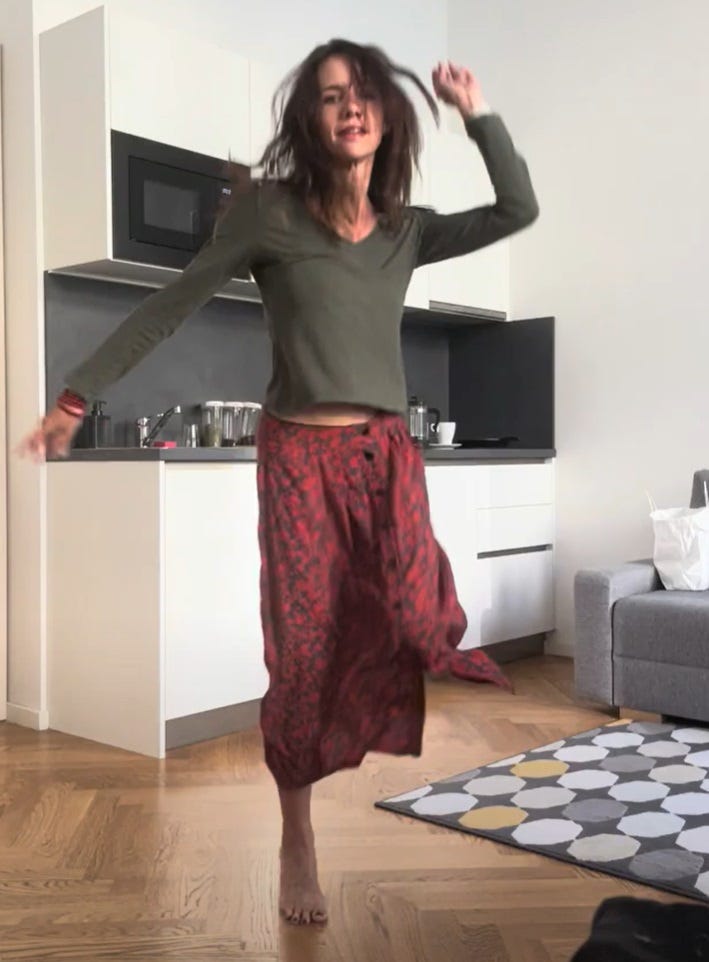
It had been awhile since I shook myself, and something interesting happened this time. I thought about my EK and I played with an idea that I both desire and that makes me feel really uncomfortable: I’m ready to take my place with the wise and mature women I admire.
And I started to get choked up. I think because the little girl, or teenage punk, or whoever, inside me that has been running the show thought she was dying. And that’s what was great about doing this experiment while I felt really strong in my body. I was able to meet that young girl, to soothe her, and not get absorbed by her.
I tried different words to tell her she didn’t have to be scared, she wasn’t dying, she was: growing, changing, transforming.
What seemed to work best was when I told her she was getting to take a rest. Because she’s been working hard to fit in and be what she thought the world wanted her to be: cool, confident, fun, and normal.
She’s frickin’ tyty and could use a lil nap.

It’s never a one-and-done with these things. My teacher reminded me this week to zoom out, notice the overall trend; it often takes much, much longer than we think it should, where “it” is being the person we desire to be, the “best version of yourself.”
Social worker and author Jessica Dore writes in Tarot for Change
In dialectical behavior therapy, the therapist’s job is to help the client hold both the need for change and the need for radical self-acceptance at once. Both are real, and both are crucial to the process.
Buddhist nun Pema Chödrön puts it more succinctly
You are perfect as you are… and you could use a little work.
So maybe try the shaking, and experiment with EK when things are FUBAR after a SNAFU and you think you’re SOL.
And remember, kids: always, always check Urban Dictionary before using acronyms. 🤫

If you are tyty and want some deep rest, join me at Yoga Under the Palms Kaka‘ako on Sunday, Feb. 17, where I’ll be leading a yoga nidrā session for the Winter Soulfest. Register for the day’s events here!
If you can’t make it in person, Yoga Nidrā Network is a great donation-based online resource.
Yoga nidrā is a conscious way to rest that invites you to nourish every aspect of yourself. It may look as if absolutely nothing is happening, but the deepest of restoration is occurring!
There are live recordings, made in cities and yoga studios, in meadows and woodlands, and recorded in 23 different languages. Each one gives you a flavour of a particular application of yoga nidrā, so you can see for yourself what a flexible practice it can be. We trust they bring peace, healing and joy into your life.
I find this one particularly helpful when I have trouble sleeping.

Sending you some TLC 🤗
Your ALY (Angry Little Yogi)
Shannon
PS …
In case you missed the “radical” but “not too exciting” inaugural sermon last week, here is a clip:
You can send postcards (no surprises) in ♡ support ♡ of Bishop Budde to:
Love these musings and images, Shannon. Thank you. And since I've off media for the past couple of weeks, I hadn't seen that clip of the Bishop. I will be sending a postcard of gratitude and praise to her.